Many people regard blockchains and cryptocurrencies as an inherently disorderly technology and culture. After all, the bedrock assumption of the technology is privacy, permission-less-ness and censorship-resistance. Spooky and scary.
 VSG@ValueStockGeek · Nov 18, 2026
And only the bad guys care about these things, right?
Well we can clearly think of many recent examples where this has not been the case. Or where at least the balance of power has dramatically shifted and the censors became the censored, and defense might be desirable. Access is routinely managed around the public square. Where new ideas can be shared and old ones challenged.
 jack@jack · Jan 14, 2021
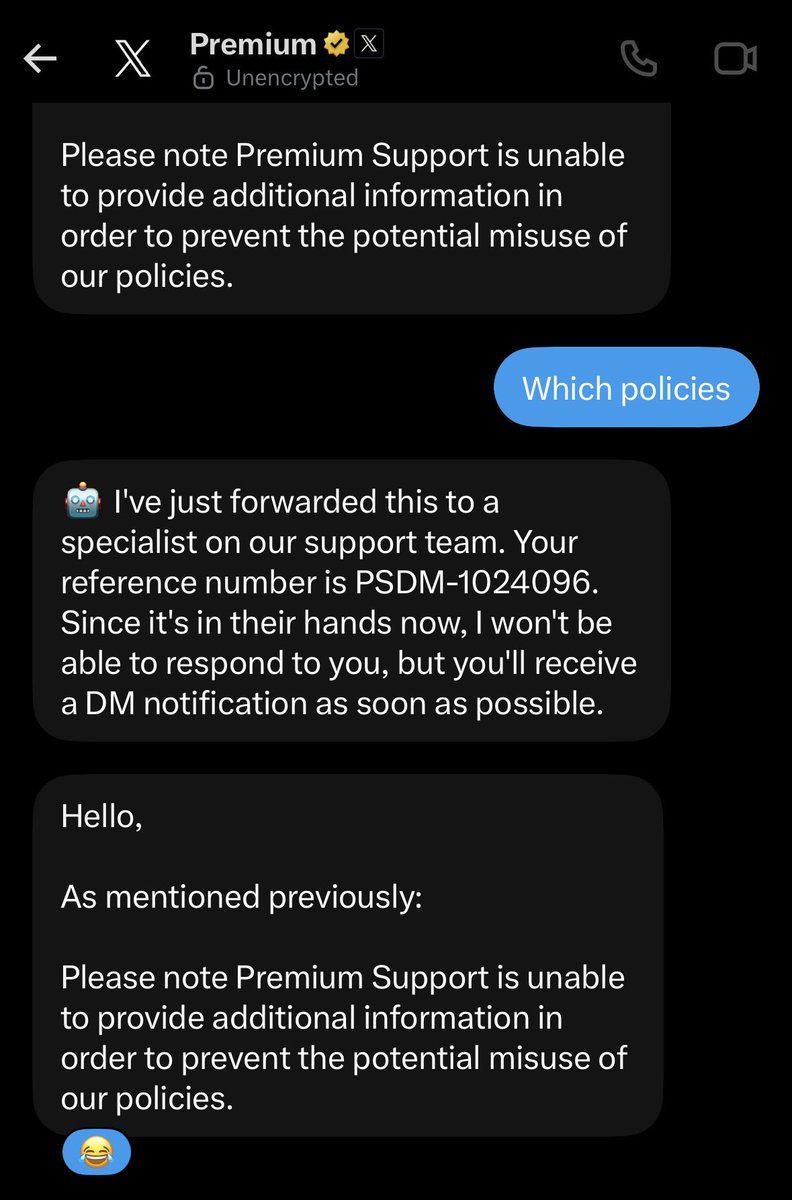
The current sitting U.S. president, whether you like him or not, was banned from this very website only 5 years ago (this was originally posted on X). And on the other end of the political spectrum, leftist journalists have been banned after the Elon takeover. Currently groyper streamer Nick Fuentes can't get a 'blue checkmark' which puts him into a sort of passive social underclass here. Obviously Nick is doing fine, but the point stands: Power to censor, will be used to censor, and that power can flip on a dime.
 Nicholas J. Fuentes@NickJFuentes · Oct 2, 2026


 422 replies · 16.8K likesView on X
Wikileaks was famously prevented from raising money and resorted to Bitcoin when it took heat for releasing tapes related to the U.S.-Iraq war and diplomatic cables and was banned from PayPal and other (centralized) payment channels. As an interesting historical note, Satoshi was not especially pleased by this development:
WikiLeaks has kicked the hornet's nest, and the swarm is headed towards us.
Particularly more so ominous as this was their second-to-last post.
But what is also interesting to consider in the Wikileaks context, was at the time, they were being heavily clapped for by those on the Left for exposing the purported misdeeds of those on the Right during the Bush presidency.
View this post by @wikileaks on XAnd how the pendulum, swings. Not so long after this, Wikileaks was heavily critiqued by the Left for its role in publishing internal comms by the Hilary Clinton campaign, reportedly at the behest of Russian state interests (see "Russiagate").

This recent history simply goes to show that the power to prevent people from speaking their mind and sharing information freely is much coveted by those in power. And in modern times, this kind of power is kind of all-encompassing - our lives are increasingly digital and can be simply "snuffed out" with a few clicks. And we cannot be so certain who will be in power tomorrow. For that reason, the cypherpunk movement is rooted in themes like "can't be evil", "credible neutrality" and "headless brands" which translates to politics as well as it does to finance, and is the expected reaction to an increasingly contentious society with more and more power to dominate outliers through digital dominion. The central theme is more or less: nobody in a true cypherpunk society has the power to prevent you from expressing yourself, ultimately, or coordinating with others to achieve your goals. Politics 010. This is not remotely a bad outcome for anyone with a head on their shoulders and that is observing the current state of affairs. And is the inevitable ending in many ways of a digital society reckoning with its own rails. (I tend to see it more as a beginning, which we will get into.)

crypto is the new e-state
I would like to pose that crypto-anarchy at this stage is impending, and is not a crisis as many would claim by connotation, but rather a welcome transition to a more humane mode of relation and governance from the dark ages of state-building that until now has been degraded in form and function to vast, overbroad delegation. Delegation which if left unchecked could lead to tyrannical results especially if aided by superhuman-intelligences.
To recall how we got here:
Thomas Hobbes has this clean picture of Leviathan as basically the construction of legitimate authority to be governed by the consent of the governed themselves. One big 'meta human': cells, interlinked. They become their own king.
The root idea is that cooperation has been the defining factor over the years in forming states and increasing economic bandwidth through the creation and enforcement of property rights, and resulting higher-standards of living because people can now specialize without all scrounging around. By keeping records of ownership and not letting brutes just take what they want. From such novel hallucinations we emerged from being dominated by the random chance of birth (some people are born bigger and more violent than others) to rule through reason and morality, which largely revolves, unsurprisingly around who gets to own what, and who gets to take what you own. New religion.
The golden rule underpins most norms here because it is common sense: do unto others as you would have them do unto you. These are the kinds of rules anyone would agree to if they did not know what they would become when they were born (veil of ignorance). We arrive at enforcing such rules to make this a livable reality through cooperation: 100 little guys can defeat 1 big maniac who would disregard them.
The ideal end-state is then that the 100 little guys continue to exalt these natural laws that underpin the point of joining such "social contract" in the first place and thereby avoid the "state of nature" (which is basically living as a hermit in the woods to avoid groups or the non-rule-following maniacs), and we continue on the ultralight beam into peaceful abundance.
This is not particularly difficult to grasp as a goal, but is helpful to enunciate in describing how the balance of power and norms around governance should now come to reflect the current technical reality that the proliferation of blockchain and cryptocurrencies provides to the modern political equation. New tools require new rules.
Notably, until very recently, a lot of cooperation among people in these large groups revolved around the impracticality of communication over long distances and the difficulty of self-storage of wealth. Hence massive amounts of delegation of power and responsibility on our behalf as part of the social contract.
Let's back it up. The 100 little guys example again. 100 little guys can easily monitor each other and ensure each other is respecting the fundamental rules of the game. But what about 1000 or 100,000 little guys? Not so easy, is it. Monitoring each other is a full-time job in that sense, and we can't be productive if most of our time is spent on governance itself. Hence the shape of most modern states is rigorous delegation to bureaucrats and property rights specialists directed overall by "law" and periodic review (elections). Most people vote on the simple basis "am I better off than I was since last time I voted." This works more or less well enough to help us keep improving standards of living and technology to which point, we arrive to today.
It is perfectly reasonable to examine the state as it is, vastly delegated and removed from everyday life, and compare it to the ideal of the internet itself. It works but it could be better. More lively, connected, vibrant. Why can't we communicate our beliefs and goals immediately and channel resources this way? Kickstarter campaigns and crowdfunding generally are a glimpse towards this kind of online-driven real-world action, and in some cases, DAOs and ICOs, for the crypto variants empowered by digitally-native stores-of-value (cryptocurrencies).
But the chief outcome is that a group of people online can accomplish things far more quickly than they would otherwise because they can reach direct consensus without intermediaries.
And towards the fundamental role of the state in maintaining common records of ownership and enforcing these rights, well, the blockchain does this as part of its core functionality and purpose as a distributed ledger.
Satoshi wrote quite plainly in the Bitcoin whitepaper as regards the current financial system (and in context, to banks basically fleecing the world economy based on their monopoly on custody):
While the system works well enough for most transactions, it still suffers from the inherent weaknesses of the trust based model.
This applies to most other things involving humans working together, too.
And it is no accident that the original author of these designs in cryptocurrencies and disintermediation of financial concerns with B-money, Wei Dai, spoke of "crypto-anarchy" quite logically as the natural consequence of private ownership (both in terms of self-custody as well as identity) mediated by code rather than legal systems alone:
in a crypto-anarchy the government is not temporarily destroyed but permanently forbidden and permanently unnecessary. It's a community where the threat of violence is impotent because violence is impossible, and violence is impossible because its participants cannot be linked to their true names or physical locations.
What I would like to suggest though as an addendum to the notion of crypto-anarchy, which most certainly is disruptive to the state-as-we-know-it through the invention of crypto, is that it merely is a transformation and not annihilation - the new crypto e-state is the reduction of the Leviathan again to its primary concerns - cooperation - enabled by the internet. Without the scaffolding that we have grown accustomed to associating with the managerial aspects of the state. Where these functions, which are reducible to various forms of bean-counting, can be purely automated by blockchain, they should be, in order to focus attention and resources on core themes, such as the American Declaration's 'Life, Liberty and the pursuit of Happiness,' or the Chinese Communist Party's core directive, '为中国人民谋幸福,为中华民族谋复兴' (seeking happiness for the Chinese people and rejuvenation for the Chinese nation). Broad strokes such as these are the lifeblood of schelling a diverse and numerous mass into one direction that can actually accomplish great things together.
Wei Dai did not explicitly anticipate DAOs, or the use of digital reputation to help create repeat dealings among otherwise anonymous users that deal in cryptocurrencies. He did conceptualize "community" in the pure approximation of state function:
A community is defined by the cooperation of its participants, and efficient cooperation requires a medium of exchange (money) and a way to enforce contracts.
And as it should be. People will enter into relationships with strangers if they reach some certainty that their rights and humanity will be respected rather than arbitrarily overruled through force. Otherwise what is the point. And we now simply have the technology, which cannot be simply forgotten, to encode basic human rights on the global stage and public square through smart contracts. Privacy. Security. And dominion. Shareable, if people wish to join resources. Free-to-exit if they wish to, as well.
Crypto and new economies built around tools that embody powers that were once reserved to bureaucrats because of their information density and coordination costs shall proliferate just as information has with the internet age. This, the new e-state, is nothing to be afraid of.